OBD code information sheet
https://dvireports.com/p0301
Cylinder 1 misfire detected
Selected definitionGeneral catalogue definition1 definitions availableChange
Choose the make reported by the scan tool or vehicle documentation. The same code can have different manufacturer meanings.
Technical explanation
The ECU detects a misfire on cylinder 1. Check ignition, injection and compression for the actual engine; stop safely if the warning light flashes.
Read the full technical explanation
P0301 identifies misfire detected at cylinder 1, not a confirmed failure of that cylinder's spark plug or coil. Cylinder numbering varies between engines and must be verified before testing. Local ignition, injection, intake or compression faults can produce the same code. Diesel diagnosis does not use the spark-plug and ignition-coil checks applicable to petrol engines.
Symptoms
Idle vibration or uneven engine running.
Hesitation and reduced power, sometimes only cold or during acceleration.
Engine light, potentially flashing during sufficiently severe misfire.
Top suspects — what to check first
Suggested checking order, not statistical failure rates or a confirmed diagnosis. Priority can change with the engine and associated codes.
Spark plug, coil or ignition circuit
Check firstSpark plug, coil, lead or ignition connector fault where fitted.
Cylinder 1 injector
Check nextCylinder 1 injector or its control circuit.
Local intake leak
Check nextLocal intake leakage or uneven air distribution.
Other possible causes
Low compression
Case-dependentLow compression caused by a valve, cylinder or timing-related mechanical problem.
All causes in the technical record
Some causes overlap with the shortlist above; this is not a probability ranking.
- Spark plug, coil, lead or ignition connector fault where fitted.
- Cylinder 1 injector or its control circuit.
- Local intake leakage or uneven air distribution.
- Low compression caused by a valve, cylinder or timing-related mechanical problem.
How to test — practical steps
Start with simple checks before buying parts. This is not a VIN-specific workshop procedure; keep clear of moving parts, fuel pressure and energized circuits.
- 1
Identify cylinder 1 and check urgency
Locate cylinder 1 from service information and check lamp behaviour; stop testing for severe rough running.
- 2
Save cylinder misfire counters
Save freeze-frame data and compare cylinder 1 misfire counts with the other cylinders.
- 3
Inspect plug, coil and connectors while cold
On petrol engines inspect plug, coil, connectors and oil/water traces with the engine off.
- 4
Test compatible parts only with an approved procedure
Component swapping is informative only when parts are compatible and the procedure permits it; fault migration is evidence, not the sole diagnostic criterion.
Detailed tests / equipment needed (advanced)
Perform only tests for which you have the correct wiring diagram, equipment and training.
Separate ignition faults from fuel and compression faults
You need:Cylinder-misfire scannerElectrical inspectionWorkshop compression test
- On petrol engines inspect plug, coil, connectors and oil/water traces with the engine off.
- Component swapping is informative only when parts are compatible and the procedure permits it; fault migration is evidence, not the sole diagnostic criterion.
- Check injector operation, wiring and intake sealing using engine-specific tests; never open pressurised injection lines.
- If the fault stays on cylinder 1, request compression/leak-down and mechanical checks. Confirm the misfire is resolved before assessing the catalyst.
What you should see: Results must match the applicable engine-specific test conditions and limits. One reading does not prove a component has failed.
Electrical, fuel, exhaust or timing measurements require suitable equipment and must not be improvised.
Full technical diagnosis — additional checks
Step-by-step diagnosis
ChecksWork through the steps before replacing parts. Adapt the checks to the manufacturer’s procedure.
Locate cylinder 1 from service information and check lamp behaviour; stop testing for severe rough running.
Save freeze-frame data and compare cylinder 1 misfire counts with the other cylinders.
On petrol engines inspect plug, coil, connectors and oil/water traces with the engine off.
Component swapping is informative only when parts are compatible and the procedure permits it; fault migration is evidence, not the sole diagnostic criterion.
Check injector operation, wiring and intake sealing using engine-specific tests; never open pressurised injection lines.
If the fault stays on cylinder 1, request compression/leak-down and mechanical checks. Confirm the misfire is resolved before assessing the catalyst.
Components to check
This list does not confirm failed components and is not a replacement recommendation. Verify the fault cause and vehicle applicability first.
- Cylinder 1 spark plug, coil and connections — spark-ignition engines only.
- Cylinder 1 injector and wiring — inspect.
- Intake seals and cylinder mechanical components — according to testing.
Make- and engine-specific notes
Documented configurations, not proven common defects for all makes or engines. Selecting a vehicle narrows the results.
No reviewed engine-specific exception is available for the selected configuration. Use only the general checks and obtain the exact engine procedure.
Notes are diagnostic leads, not proven faults or disassembly instructions. Do not work on brakes, fuel systems or hot components without proper training.
Check the fuses before ordering a part
An OBD code describes a detected condition; it does not tell you which part to replace. Start with the fuse for the affected circuit.
If the fuse is good, carry on like this:
- Check the relevant supplies and connectionsWhere the diagnostic procedure calls for electrical checks, verify supply, ground and connectors under the manufacturer’s activation conditions.
- Run the specified component testUse the manufacturer’s test for this code and component before deciding it has failed.
- Order only after the fault is demonstratedReplace a part only when the prescribed tests identify it as defective.
Check details
- Identify the circuit and any relevant fuse: Confirm the vehicle, engine, code meaning and stored operating conditions first. A fuse link is a location aid, not evidence that the fuse caused this code. Use the specified type and rating; do not repeatedly replace a fuse that opens.
- Check the relevant supplies and connections: Use the specified engine state, circuit conditions and expected values. Have live measurements performed by someone qualified. For non-electrical faults, follow the relevant mechanical, fluid, pressure or leak checks instead.
- Run the specified component test: Do not apply a generic resistance range. Any resistance or continuity test requires a de-energized circuit and an isolated component, with the correct pins and temperature from the procedure. Some components need a different kind of test.
- Order only after the fault is demonstrated: If results are normal, continue the relevant wiring, control, mechanical or intermittent diagnosis. Check for related faults and verify the repair under the required conditions. A code or a completed checklist alone does not justify replacement.
If the procedure involves airbag/SRS, pretensioners or a high-voltage system, stop DIY testing and use qualified service. Do not probe these circuits with a multimeter.
Vehicle experiences and cases
User-reported cases published after moderation. Approval does not verify the diagnosis; the same code can have different causes.
No experiences have been published for this definition yet. You can be the first to share the checks and outcome.
See all vehicle experiencesManuals, components and vehicle guides
Find the relevant procedure in the workshop manual for your vehicle. A fault code alone does not identify a failed part, powertrain or exact schematic.
Manuals open at their original source. Exact diagram availability depends on the build year, engine and manufacturer access.
System and diagnostic diagrams
Conceptual illustrations of the system; verify the actual configuration and tests in vehicle-specific documentation.
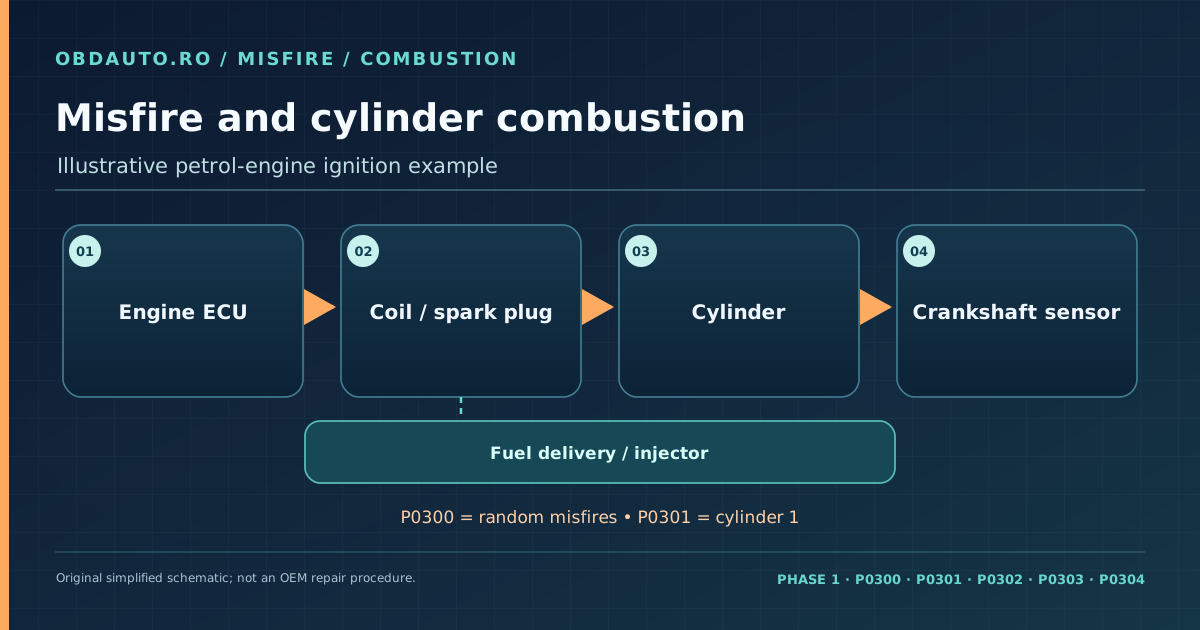
Misfire and cylinder combustion
Illustrative petrol-engine ignition example. Original conceptual diagram, not an exact component location or an OEM repair procedure.
View full-size diagram →Can I fix it myself?
Once the cause is confirmed, open the job sheet: difficulty, time, tools, parts and steps. Common jobs for P0301:
How to fix P0301: step-by-step guide
Symptoms, causes, visual inspection, scan-tool or multimeter tests, replacement and clearing the code, with safety warnings.
Irregular combustion and misfire
General system guidance · not a confirmed diagnosis
Misfire may arise from ignition, fuelling or mechanical condition. Confirm cylinder numbering for the exact engine.
The association is based on the imported description. This information explains the system; it does not confirm a procedure for the exact code, model or engine. Verify applicability in manufacturer documentation.
Checks for this type of system
- Save codes and compare affected cylinders.
- Check spark ignition only on engines equipped with it.
- Separate injection, intake and compression concerns through workshop tests.
Useful diagnostic data, where available
- Per-cylinder misfire counts where supported.
- Fuel trims and occurrence conditions.
Normal values and thresholds vary by vehicle and are not assumed here.
Mistakes to avoid
- Not every misfire is a failed coil.
- Do not apply spark-plug tests to diesels.
System-guide sources
References support general principles, not individual verification of every associated code.
Continue your research
Links to related systems, warning lights and vehicle examples.
Similar codes
General code
Random/multiple cylinder misfire
Engine & powertrain · Cylinder combustion
General code
Cylinder 2 misfire detected
Engine & powertrain · Cylinder combustion
General code
Cylinder 3 misfire detected
Engine & powertrain · Combustion / misfires
Report a problem
Is this code showing on your vehicle?
See the code meaning and catalogue checks for free. Continue with contextual AI analysis on a PRO plan.
Interpret this code in context.
Describe symptoms, add up to 3 photos and scanner codes if available. Get AI guidance, a PDF and a link for your mechanic — RON 5 / USD 2 / EUR 2 / GBP 1 per case, no subscription.
Vehicle reportsFree: 5 reports a month
Want to send this diagnosis to your customer or keep it in a clean PDF with your logo?
Generate a complete report: OBD codes, findings, photos and recommendations, with your workshop details. You can import the codes straight from a photo of the scan tool.
- Your logo and workshop details
- Import codes from a photo
- Photos and findings
- 13 languages and the customer's currency
5 free reports every month; try it straight away, no subscription.